
Cyclical Behavior in Large Location Games, with Gary Charness, Daniel Friedman, and Weinan Gong
Lowdown: This paper discovers that no Nash equilibria in my 2017 paper with Anderson (and Park) are approximated in experiments. Rather, cyclical behavior is the robust prediction in this game. This suggests a major critique of the practical application of Nash equilibrium in location games.
Formal Abstract: Location games capture important economic phenomena ranging from preemption to choice of bank leverage. We explore a parametric family of location games with many players, each facing a conflict between maximizing a fundamental payoff component and a relative (or quantile dependent) component. Using simulations and human subject experiments we show that, behaviorally, the stationary Nash equilibria in such games are terrible predictions of behavior and payoffs when players can freely adjust their locations. Instead, large cycles consistently emerge, in which behavior slowly grows bolder over time. This corresponds to progressively earlier timing in pre-emption games or to increasingly later timing in wars of attrition. When locations are maximally bold, namely at the end of the domain of Nash play, behavior quickly reverts to the peak fundamental and a new cycle begins.
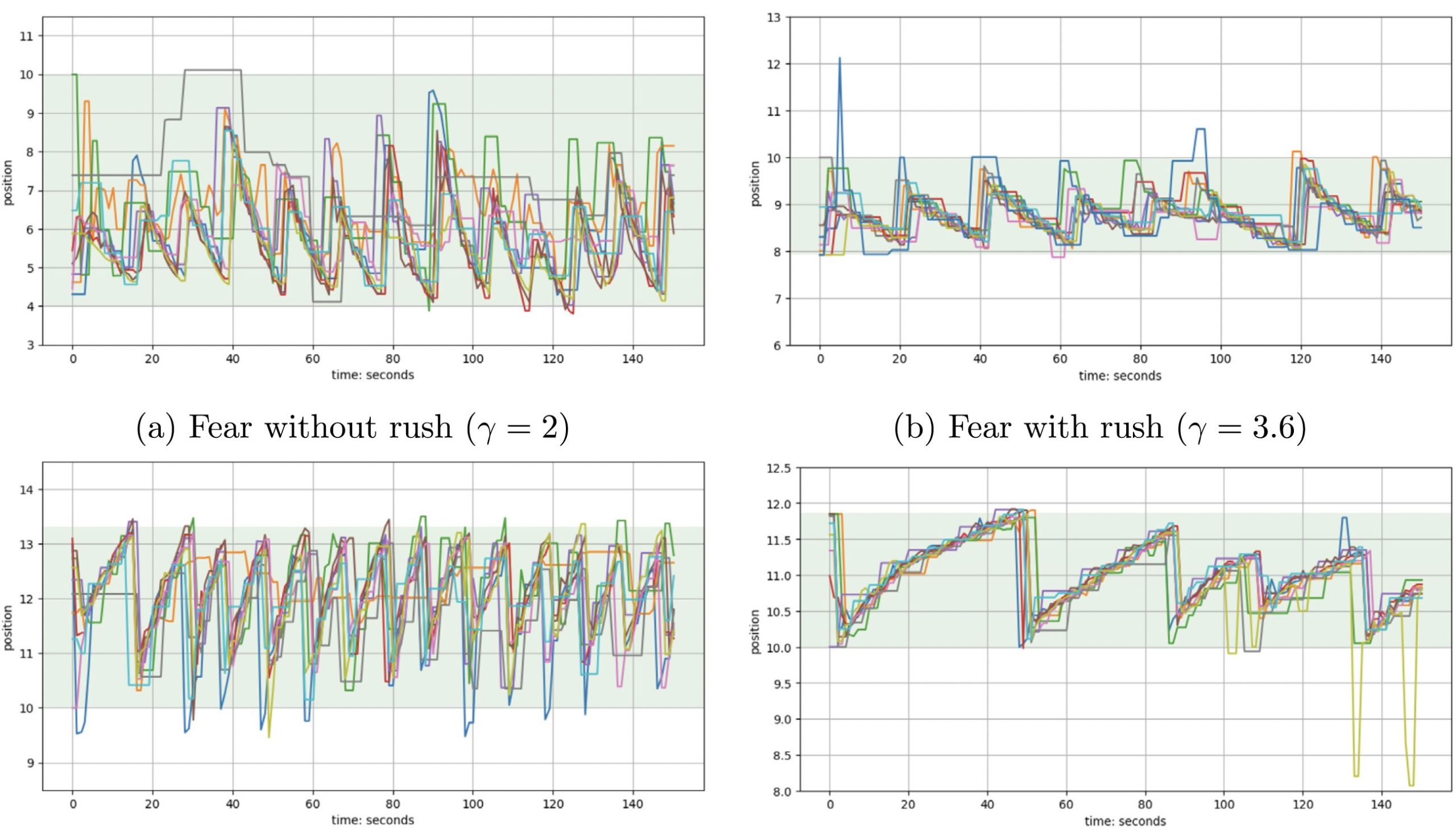 Location Dynamics are plotted over time in selected rounds
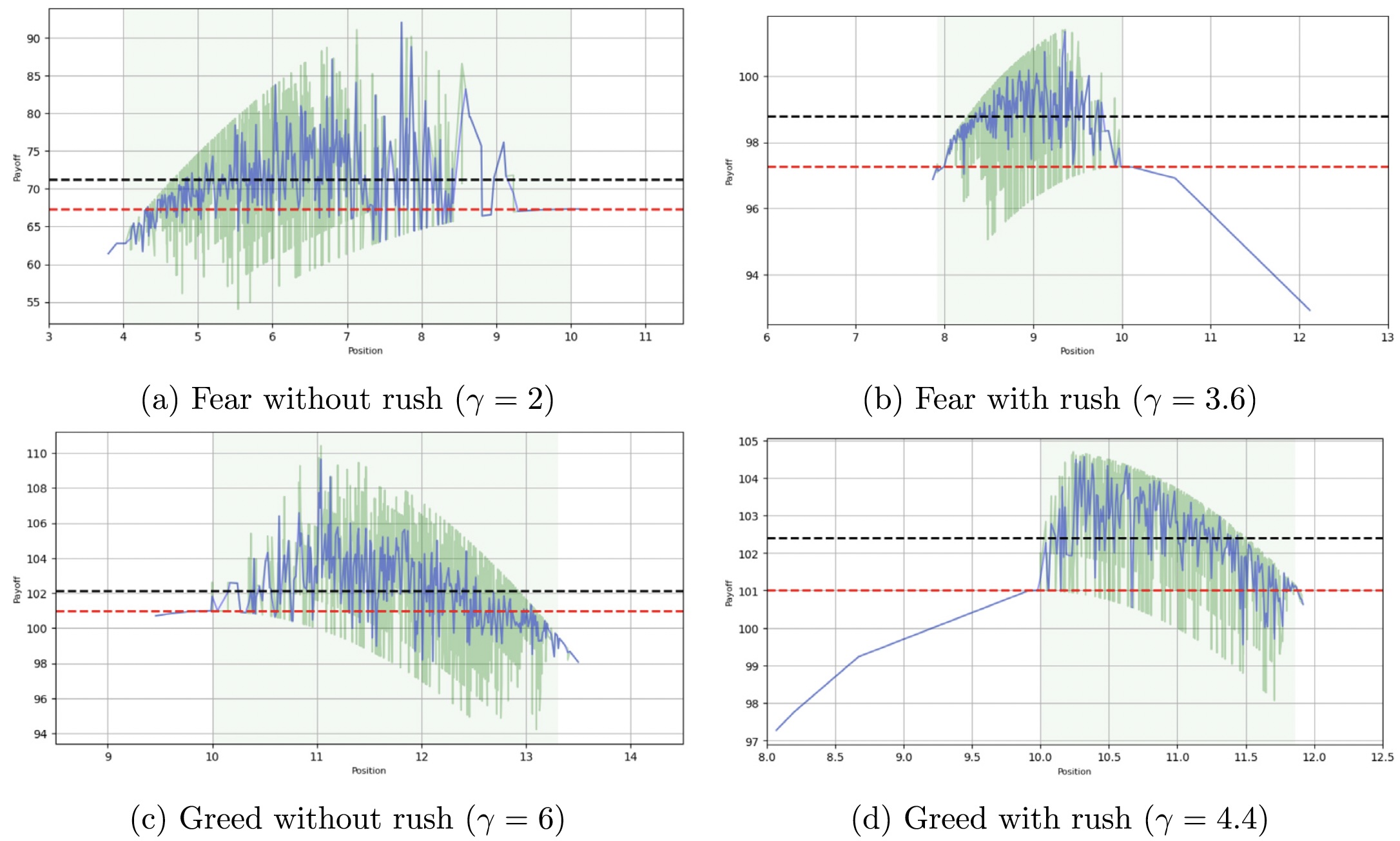 Payoff by Location: The green lines indicate individual payoffs and the blue line shows the average payoff. Both exceed the dashed red Nash payoff by 1% to 6%